
Introduction
Fatty liver disease has quietly become one of the most widespread health conditions, often with no discernible symptoms and buildup within the liver. When your doctor suggests tests like FibroScan or FibroTouch, one question immediately comes to mind: Which one provides better insight? Which detects liver damage earlier?
Think of your liver like a sponge; at first, it absorbs fat. Over time, that sponge becomes stiff and scarred, increasing the chances of reverse damage and avoiding serious outcomes such as cirrhosis or transplant. FibroScan and FibroTouch come into play here to detect stiffening.
This article breaks everything down in straightforward English—no medical jargon to worry about here! By the end, you’ll understand which technique detects damage earlier and fits into long-term liver care: FibroTouch or FibroScan?
1. What Is Fatty Liver Disease?
Fatty liver disease occurs when excessive fat accumulates within liver cells. At first, this may not pose much harm, but over time it may lead to inflammation, scarring (fibrosis), cirrhosis, and eventually liver failure.
Key Point:
-
Fatty liver can often develop unnoticed
-
By the time symptoms emerge, damage has already been done
2. Why Early Diagnosis of Liver Damage Is Important
Locating liver damage early can be like fixing a crack before the entire building collapses. Early-stage fatty liver can often be reversed with lifestyle modifications, medications, and monitoring.
Early diagnosis helps:
-
Reduce permanent scarring
-
Prevent disease progression
-
Improve long-term outcomes
FibroScan and FibroTouch non-invasive tests are a game-changer.
3. What Is FibroScan?
FibroScan is a non-invasive diagnostic test which measures:
-
Liver stiffness (fibrosis)
-
Fat content (steatosis)
This device utilizes ultrasound-based vibration technology and has been in widespread use worldwide for many years.
Simple explanation:
FibroScan measures how hard or soft your liver is; stiffer livers often indicate greater damage.
4. How FibroScan Works
FibroScan sends harmless vibrations through a probe placed on your skin into your liver. These waves travel faster through stiff tissue.
The test:
-
Takes approximately 5–10 minutes
-
Is painless
-
Requires no needles or anaesthesia
Instant results make this the ideal method for quick screening.
5. What Is FibroTouch?
FibroTouch is an advanced elastography device similar to FibroScan that utilizes more sophisticated signal processing and imaging integration techniques.
FibroTouch has gained increasing traction across Asia due to its adaptability and improved readings among certain patient groups.
6. How FibroTouch Works
FibroTouch emits mechanical waves into liver tissue and combines this technology with enhanced ultrasound imaging for more effective targeting.
Why this matters:
-
Accurate targeting allows earlier detection of mild fibrosis
-
Subtle liver changes are less likely to be missed
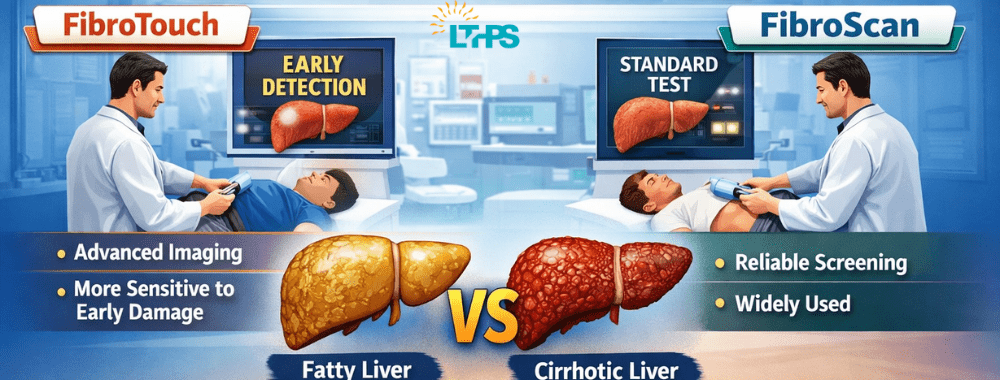
7. Comparison Between FibroTouch and FibroScan: Key Differences
Technology
-
FibroScan: Standard vibration-controlled elastography
-
FibroTouch: Elastography with imaging support
Detection capability
-
FibroScan: Ideal for moderate to advanced fibrosis
-
FibroTouch: More sensitive for early-stage damage
Patient adaptability
-
FibroTouch works better for obese patients
8. Which Test Predicts Fatty Liver Damage Early?
Here’s the honest answer: FibroTouch may detect early liver stiffness slightly earlier than FibroScan in mild and borderline cases of fibrosis.
Think of FibroScan like a camera that provides reliable HD resolution.
FibroTouch is like a lens with enhanced low-light performance—capable of picking up subtler changes sooner.
Both devices are effective, but FibroTouch may detect early damage more efficiently.
9. Accuracy for Obese and Diabetic Patients
Obesity and diabetes pose significant risks for fatty liver and create testing challenges.
FibroScan limitations:
-
Reduced accuracy in obese patients
-
Special probes may be required
FibroTouch advantages:
-
Improved tissue penetration
-
More consistent readings
This makes FibroTouch more practical in real-world clinical settings.
10. Comparative Comparison of Comfort, Time, and Safety
Both tests are:
-
Completely painless
-
Needle-free
-
Free from radiation exposure
-
Completed in less than 10 minutes
There is virtually no difference in patient comfort between the two.
11. Cost and Availability in India
-
FibroScan: Widely available, sometimes at a slightly higher cost
-
FibroTouch: Availability varies by city and hospital
Both tests are significantly cheaper and safer than liver biopsy.
12. Are These Tests an Alternative to Liver Biopsy?
Yes, in many cases.
FibroScan and FibroTouch reduce the need for biopsy in:
-
Fatty liver disease
-
Chronic hepatitis
-
Early fibrosis
However, biopsy may still be required when:
-
Results are unclear
-
Cancer is suspected
-
Severe liver damage is present
13. When Test Results Indicate Serious Injury or Malfunction
If either test shows:
-
High liver stiffness
-
Advanced fibrosis
-
Cirrhosis
Doctors may recommend:
-
Advanced imaging
-
Long-term monitoring
-
Consultation with a liver specialist or the best liver transplant surgeons in India
Early planning can save lives.
14. Tests Prior to Liver Transplant
Before transplant decisions, doctors monitor:
-
Disease progression speed
-
Remaining liver function
FibroTouch and FibroScan help determine:
-
Urgency of transplant
-
Response to treatment
These tests play a vital role in transplant evaluation pathways.
15. Tips on Selecting an Appropriate Test for You
Choose FibroScan if:
-
You prefer a globally established test
-
Your body weight is within normal range
Choose FibroTouch if:
-
You are obese or diabetic
-
You want earlier detection of subtle liver damage
Ultimately, medical expertise matters more than the machine.
Conclusion
Fatty liver disease doesn’t yell—it whispers. FibroScan and FibroTouch both help doctors hear those whispers early. While FibroScan remains the standard choice, FibroTouch often excels at identifying early damage linked to modern lifestyles.
The key to effective liver care is not just the test, but timely diagnosis, proper follow-up, and expert medical guidance. Early action can mean the difference between lifestyle correction and lifelong liver disease.
Frequently Asked Questions (FAQs)
1. Does FibroTouch outperform FibroScan for fatty liver condition?
FibroTouch may detect early liver damage sooner, especially in obese patients, but both tests are reliable.
2. Are FibroScan and FibroTouch painful procedures?
No, both tests are completely painless and non-invasive.
3. Can fatty liver disease be reversed early on?
Yes, early-stage fatty liver can often be reversed with lifestyle changes and medical treatment.
4. Do I still require a liver biopsy following these tests?
Not usually. Biopsy is only needed if results are unclear or severe disease is suspected.
5. When should I consult the best liver transplant surgeon in India?
If tests show advanced fibrosis, cirrhosis, or worsening liver function, early consultation is essential.